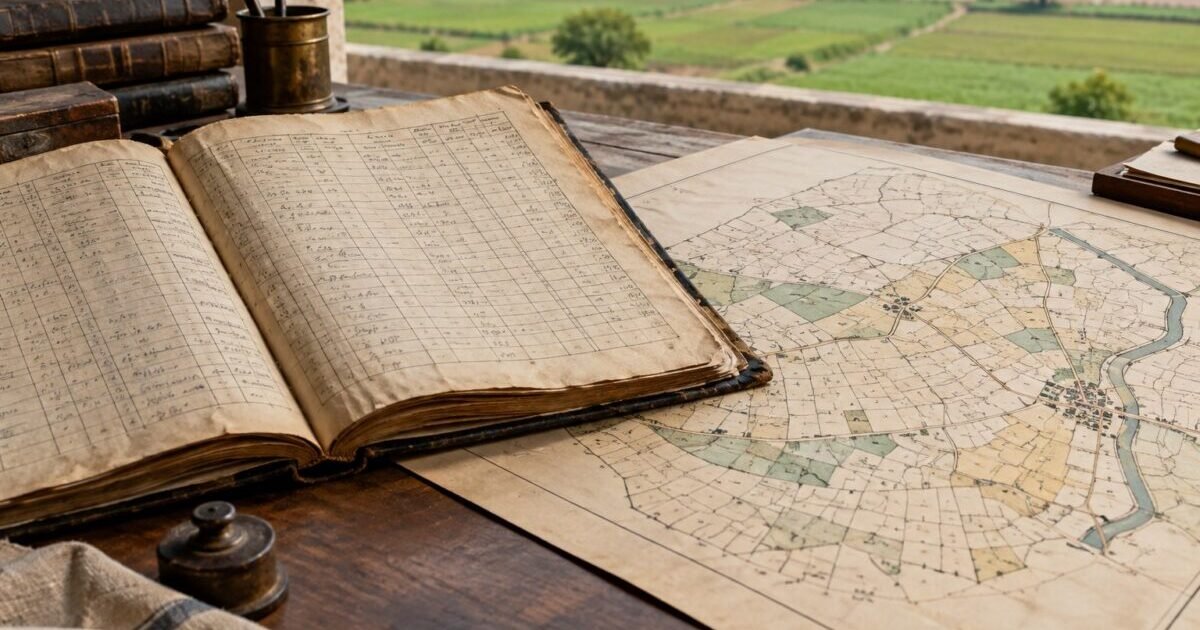

Lal Kitab Land Records are part of the older revenue-record system used in parts of northern India. In land-record terminology, the name generally refers to a village, tehsil, or district notebook containing compiled statements and statistical information used by the revenue administration. It is not the same thing as a Jamabandi, Khasra Girdawari, mutation register, or property sale deed.
The term can be confusing because Lal Kitab is also widely known as the name of an astrological tradition. In this article, we are discussing the land-revenue meaning of Lal Kitab: a historical administrative record associated with village and revenue information.
For researchers working with old property papers, understanding this distinction matters. A Lal Kitab entry may provide useful background about a revenue estate, but it should normally be read together with the other records for the same village, period, and parcel.
What Is Lal Kitab in Land Records?
In the land-revenue context, Lal Kitab refers to a village or revenue notebook containing compiled statements about the local estate. Historical land-record systems maintained several registers for different purposes. Lal Kitab was one of the record types used to organize broader village-level information rather than simply identify one person’s ownership of one parcel.
The Punjab Land Revenue Rules specifically list statements contained in village note-books called Lal Kitab among the records maintained within the revenue system. This helps distinguish the land-record Lal Kitab from the unrelated astrological text that has the same name.
The exact format and contents can vary according to the applicable revenue manual and period. Therefore, it is safer to treat Lal Kitab as a category of historical revenue notebook rather than assume that every Lal Kitab contains an identical set of columns.
What Information Can a Lal Kitab Contain?
Because Lal Kitab was designed for administrative and statistical use, it can contain information that helps officials understand the broader condition of a village or revenue estate. Depending on the state, settlement period, and record form, researchers may encounter information relating to:
- Village and revenue-estate details: basic information used to identify the estate and its administrative setting.
- Land and cultivation statistics: summaries connected with agricultural land, cultivation, or land use.
- Soil and agricultural information: classifications or statistics used in revenue and agricultural administration where included in the relevant record.
- Irrigation resources: information about wells, canals, or other sources of irrigation where the applicable record includes it.
- Livestock or cattle information: statistical details that may appear in historical village records.
- Revenue and assessment information: figures or statements used by the revenue administration.
- Historical village statistics: compiled information that can help researchers understand how an estate was recorded at a particular time.
These should be treated as examples, not a universal checklist. An old Lal Kitab from one state or settlement period may contain different information from another. The original record form and the relevant revenue manual are the best guides to interpreting a particular entry.
Lal Kitab vs Jamabandi vs Khasra Girdawari
One of the biggest content gaps in many explanations of Lal Kitab is the failure to distinguish it from other revenue records. The following comparison makes the difference easier to understand.
| Record | Main purpose | Typical research use |
|---|---|---|
| Lal Kitab | Compiled village or revenue-estate statements and statistics | Understanding broader historical village and revenue conditions |
| Jamabandi | Record-of-rights and related landholding information | Researching recorded rights, holdings, shares, and revenue entries |
| Khasra Girdawari | Field inspection and cultivation information | Checking recorded crop, cultivation, and field conditions for a period |
| Khasra | Parcel or field identification | Identifying a particular survey or parcel number |
| Mutation | Recording changes in revenue records following events such as inheritance or transfer | Tracing changes recorded after a transaction or succession event |
If you are starting with a parcel number, our Khasra Number guide explains how the number is used in land records. You can also read the Khatoni Number guide and Khewat Number guide to understand related revenue identifiers.
Why Is Lal Kitab Important for Historical Land Research?
1. It Adds Village-Level Context
A Jamabandi or Khasra entry can tell you about a particular holding or parcel. Lal Kitab can provide a wider administrative picture. This makes it useful when researching how a village or revenue estate was organized during an older settlement period.
2. It Helps Compare Different Revenue Records
Historical land research often involves comparing several documents rather than relying on one paper. A Lal Kitab entry can be considered alongside Jamabandi, Khasra Girdawari, mutation records, maps, field books, and other settlement documents.
If two records appear to disagree, do not immediately assume that one is incorrect. First compare the year, settlement period, village, parcel identifier, terminology, and purpose of each record. Different registers may record different aspects of the same estate.
3. It Can Help With Historical Property Research
Researchers tracing ancestral agricultural land may encounter references to older village notebooks or statistical registers. These records can help establish historical context, especially when combined with names, village boundaries, Khasra numbers, and settlement-era documents.
4. It Helps Explain Old Revenue Terminology
Older land records often contain terminology that is unfamiliar to modern property owners. Understanding where Lal Kitab fits into the wider revenue-record system makes it easier to interpret references to Jamabandi, Girdawari, Khewat, Khatoni, field books, and settlement records.
Lal Kitab Land Records in Punjab
Punjab is particularly relevant when researching the land-record meaning of Lal Kitab. The Punjab land-record framework recognizes village note-book statements under the name Lal Kitab. Historical revenue records in the region also include Jamabandi, Khasra Girdawari, field books, mutation records, and other documents.
The official Punjab Land Records portal currently provides online services for viewing Jamabandi and searching by owner name, Khewat number, Khasra number, and Khatouni number. These online services are useful for current and digitized records, but they should not be assumed to contain every historical Lal Kitab volume.
For a broader overview, see our Punjab Jamabandi guide. If the document is written in older Urdu terminology, our Urdu Revenue Terms guide can also help with common vocabulary.
Lal Kitab Land Records in Haryana
Haryana inherited a revenue-record tradition closely connected with the broader Punjab system, but the exact record structure and terminology can vary by period and administrative rules. When researching an old document, identify the district, tehsil, village, settlement period, and record type before assuming that a term has the same meaning as it does in a modern online portal.
For current Haryana land-record research, compare historical documents with the appropriate official revenue services. Our Haryana Jamabandi guide explains the relationship between Jamabandi, Khasra, Khewat, and Khatoni in the Haryana context.
Is Lal Kitab the Same as Jamabandi?
No. Lal Kitab and Jamabandi are different types of revenue records.
Jamabandi is generally associated with the record-of-rights and landholding information maintained by the relevant revenue administration. Lal Kitab, by contrast, refers to compiled statements in village or revenue notebooks. A Lal Kitab may therefore provide broader statistical or administrative context rather than serving as a direct substitute for a Jamabandi or ownership record.
When researching ownership, do not rely on the name of a person appearing in a historical statistical record alone. Review the complete set of applicable revenue and property documents and check the relevant state procedure.
Is Lal Kitab the Same as Girdawari?
No. Girdawari is primarily associated with field inspection and crop or cultivation information. Lal Kitab is a broader village or revenue-notebook record containing compiled statements and statistics.
These records can complement each other. For example, a researcher might use Girdawari to understand recorded cultivation during a particular season and consult other village-level records to understand the wider historical context.
Our detailed Khasra Girdawari guide explains crop inspection records, their purpose, and how they differ from Jamabandi and Khasra records.
How to Find Old Lal Kitab Land Records
Finding an old Lal Kitab is different from checking a current Jamabandi online. Historical registers may not be fully digitized, and availability depends on the state, district, record period, and preservation system.
- Identify the village: Record the exact village name, tehsil, district, and state.
- Identify the period: Look for the settlement year, assessment period, or other date shown on the document.
- Note related identifiers: Record Khasra, Khewat, Khatoni, owner, cultivator, and other names or numbers appearing in related papers.
- Check the official land-record portal: Start with the state government’s revenue or land-record website to see what has been digitized.
- Ask about historical registers: If the required Lal Kitab is not online, contact the appropriate revenue, record room, tehsil, district record office, or archival authority.
- Compare supporting documents: Use Jamabandi, Girdawari, mutation records, maps, and settlement papers to cross-check the information.
For Punjab, the official land-record portal provides online access to several record services, including Jamabandi, mutation, registered deed, and related searches. It does not follow that every older village notebook is available online, so historical research may still require local record sources.
How to Read an Old Lal Kitab Entry
Old revenue documents can be difficult to read because handwriting, abbreviations, terminology, and scripts changed over time. Start by identifying the document’s village, year, record type, column headings, names, and parcel references.
If your family records are from regions where Kaithi was historically used, our Kaithi Script Guide can help you understand the script and its use in historical revenue documents. For handwritten material, you can also consult our Kaithi Handwriting guide. For older Urdu revenue papers, see our Urdu Land Records guide.
Common Mistakes When Researching Lal Kitab
- Confusing land-record Lal Kitab with astrology: The same name is used in a completely different context.
- Treating Lal Kitab as a universal format: Historical revenue records vary by state, settlement, and period.
- Using Lal Kitab as a replacement for Jamabandi: Different registers have different administrative purposes.
- Assuming every old record is online: Digitization is incomplete and differs across jurisdictions.
- Ignoring the record date: A historical entry describes a particular period and should not automatically be treated as a current record.
- Reading one document in isolation: Cross-checking related revenue records usually gives a more reliable historical picture.
Frequently Asked Questions About Lal Kitab Land Records
What is Lal Kitab in land records?
Lal Kitab is a historical revenue notebook containing compiled village or estate-level statements and statistics. The exact contents depend on the applicable revenue system and period.
Is Lal Kitab a land ownership record?
Not in the same sense as a record-of-rights or Jamabandi. Lal Kitab is a broader revenue notebook, so an entry should be interpreted according to its record type and historical context.
Can I check Lal Kitab online?
There is no single all-India Lal Kitab portal. Some related land records are available through state portals, but historical village notebooks may require access through revenue offices, record rooms, or archival sources.
Is Lal Kitab the same as Khasra Girdawari?
No. Khasra Girdawari is associated with field inspection and crop or cultivation information, while Lal Kitab refers to compiled statements in village or revenue notebooks.
Is Lal Kitab the same as Jamabandi?
No. Jamabandi generally relates to record-of-rights and landholding information, while Lal Kitab provides broader village or revenue-estate statements.
Where should I start if I have an old Lal Kitab reference?
Start by recording the village, district, tehsil, year or settlement period, and every Khasra, Khewat, Khatoni, and personal name shown in the related documents. Then check the official state land-record system and the appropriate local record authority.
Final Takeaway
Lal Kitab Land Records are best understood as historical village or revenue notebooks containing compiled administrative and statistical information. They are valuable for historical land research because they can add context that is not always visible in a single Jamabandi, Khasra, or Girdawari entry.
The most reliable approach is to treat Lal Kitab as one part of a larger record set. Compare it with Jamabandi, Khasra Girdawari, mutation records, maps, field books, and other documents from the same village and period. For current ownership or legal purposes, always verify the latest official records and applicable procedures with the relevant authority.