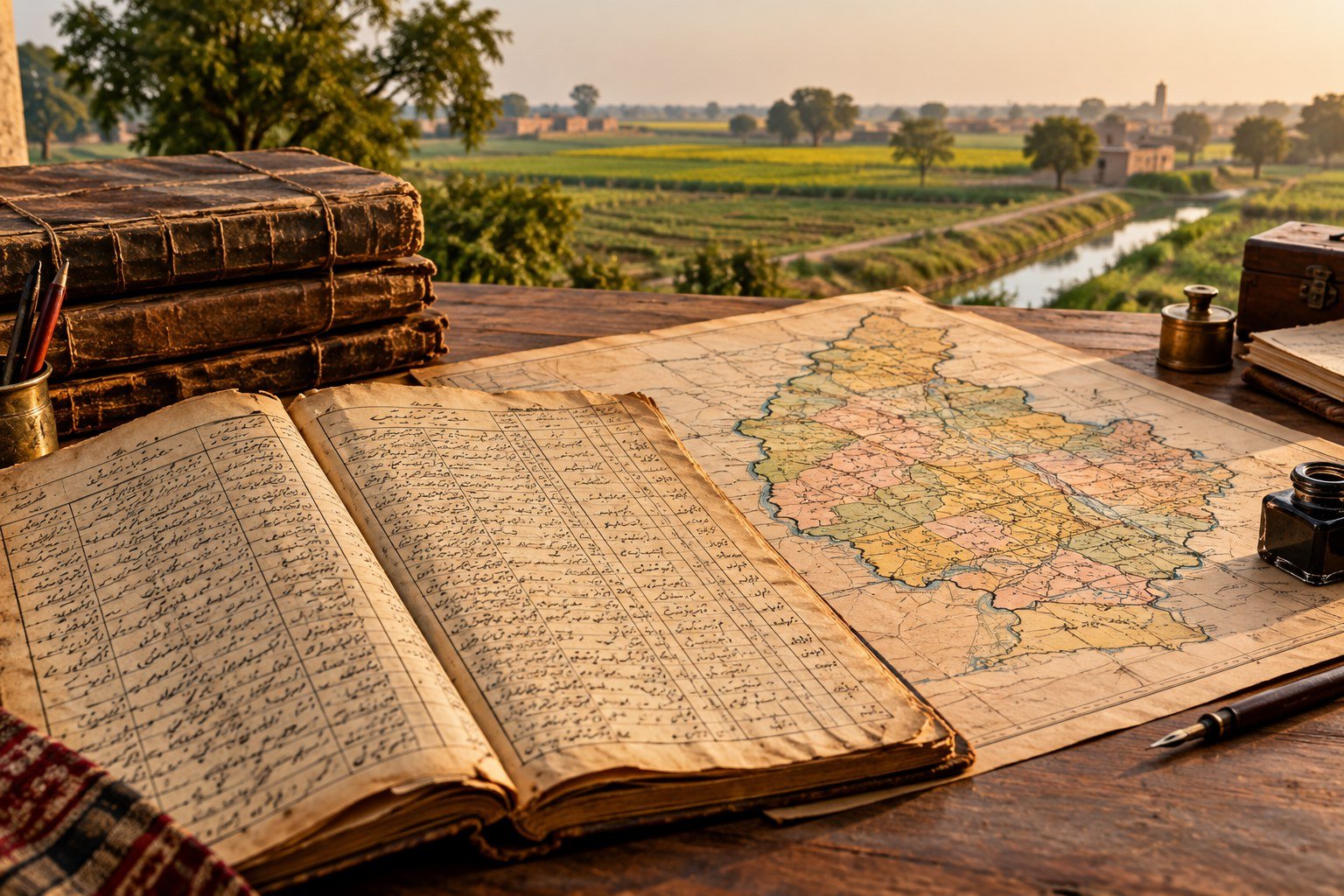
Punjab & Haryana Urdu Jamabandi: Complete Guide to Old Land Records
Punjab & Haryana Urdu Jamabandi is a practical research topic for anyone studying old land records, ancestral property, village history, or pre-digital revenue documents. Historical records from the Punjab region can contain Urdu handwriting, Persian-influenced revenue terminology, local expressions, old measurements, and administrative abbreviations. That is why simply knowing the Urdu alphabet is not always enough.
This pillar guide explains how to approach Punjab & Haryana Urdu Jamabandi records, understand their main identifiers, compare Punjab and Haryana systems, use current official portals, and avoid common research mistakes. It is written for Indian readers researching historical documents while keeping current 2026 land-record developments in view.
Important: This is an educational guide. A historical Jamabandi can provide valuable evidence and context, but it is not automatically a final statement of present legal title. For inheritance, sale, partition, litigation, or title verification, use applicable certified records and qualified professional advice.
What Is Punjab & Haryana Urdu Jamabandi?
Jamabandi is a traditional land and revenue record associated with recorded rights, holdings, cultivation, and related revenue information. Its exact format can vary according to the state, settlement period, village, and historical revenue practice.
The word Urdu in this topic describes the language or script found in historical records. It does not mean that every Punjab or Haryana Jamabandi was written entirely in Urdu. Depending on the period, a record may contain Urdu handwriting, Persian-derived terms, local vocabulary, numerals, abbreviations, and later additions in another script.
This is important because a modern Urdu reader can still find an old revenue register difficult to understand. The challenge is often the combination of handwriting, technical vocabulary, record structure, and historical context.
Why Punjab & Haryana Urdu Jamabandi Records Matter
A Punjab & Haryana Urdu Jamabandi record can provide a snapshot of a village or holding at a particular point in time. For family-history and land-record research, the document may help connect names, parcels, shares, cultivators, and later changes.
Depending on the record and period, you may encounter:
- Owner or recorded rights-holder names
- Khewat numbers
- Khatauni numbers
- Khasra or field numbers
- Area and shares
- Cultivator or tenancy information
- Irrigation details
- Revenue or rent information
- Mutation or Intkal references
- Village, Patti, or Taraf references
- Remarks about changes in the holding
The real research value of Punjab & Haryana Urdu Jamabandi research appears when several records are compared. One Jamabandi can show a historical position; a sequence of Jamabandis, mutations, deeds, maps, and related records can help build a much stronger timeline.
Why Reading Punjab & Haryana Urdu Jamabandi Is Difficult
Old Handwriting
Historical Urdu handwriting can differ substantially from modern printed Urdu. Letters may be tightly connected, strokes may be faint, and different writers may use different styles. Read uncertain words against similar entries on the same page instead of translating an isolated word.
Technical Revenue Vocabulary
A general Urdu dictionary may not explain the technical meaning of a term in a revenue register. Historical interpretation therefore requires the script, the word, and the administrative context to be considered together.
Faded or Damaged Documents
Old pages may contain faded ink, stains, folds, torn edges, overwriting, or missing portions. A single missing stroke can affect a name or number.
Numbers and Measurements
Numbers deserve special attention. A wrong digit in a Khasra, Khewat, Khatauni, year, area, share, or mutation reference can lead to the wrong record.
Key Terms in Punjab & Haryana Urdu Jamabandi
Khewat Number
Khewat is an important identifier in the traditional land-record structure and is commonly associated with an ownership or holding group. Its precise use should always be interpreted from the applicable record and jurisdiction.
Read our Khewat Number guide for a deeper explanation.
Khatauni Number
Khatauni is another important land-record identifier and is commonly associated with a holding or cultivation account. Khewat and Khatauni should not automatically be treated as the same thing; read the column structure of the particular Jamabandi.
Khasra Number
A Khasra number generally identifies a particular field or land parcel. It is especially useful when connecting a historical entry with a specific piece of land.
For a detailed explanation, see our Khasra Number guide.
Khasra Girdawari
Khasra Girdawari is associated with field-level and cultivation information. Comparing it with a Jamabandi can help researchers understand the relationship between a holding and cultivation entries.
See our Khasra Girdawari guide.
Mutation or Intkal
Mutation, often referred to historically as Intkal, records a change that is reflected in revenue records. Depending on the circumstances, the change can relate to inheritance, transfer, partition, or another recognized event.
Fard
Fard commonly refers to an extract or copy of land-record information. The exact document, purpose, and certification process depend on the applicable state system.
Rapat and Roznamcha
These terms can appear in Punjab land-record research and can provide additional context about proceedings or events recorded by the revenue administration.
How to Read Punjab & Haryana Urdu Jamabandi Step by Step
Do not begin by translating every Urdu word. Start with the record structure and work toward the difficult terms.
Step 1: Identify the Record
- Village
- Tehsil
- District
- Year or Jamabandi period
- Record type
- Page or register reference
This establishes the historical context before you interpret individual entries.
Step 2: Identify the Main Columns
Traditional Jamabandi formats commonly organize information around holding numbers, owners, cultivators, fields, area, irrigation, revenue, and remarks. Historical formats can differ, so use the document itself as the primary guide.
Punjab land-revenue rules describe Jamabandi fields including Khewat, Khatauni, owner, cultivator, irrigation, field number, area, rent, rights or shares, revenue demand, and remarks. This is a useful framework, but it should not be imposed mechanically on every historical page.
Step 3: Identify Names Carefully
Compare a person’s name across several rows or pages. Check father’s name, village, family references, and repeated spelling patterns. Historical spelling may differ from modern spelling.
Step 4: Record Every Important Number
Create a research table containing Khewat, Khatauni, Khasra, year, area, share, mutation reference, and page number. This simple habit prevents many transcription errors.
Step 5: Build a Revenue-Term Glossary
Write down every unfamiliar term and compare it with repeated examples in the same document. Our Urdu Revenue Terms glossary can help with background research.
Step 6: Compare Related Records
Where available, compare Jamabandi with Girdawari, mutation entries, registered deeds, maps, and later Jamabandis. This converts a single document into a historical timeline.
Punjab Jamabandi: What You Can Check Online in 2026
Punjab’s official land-record portal is a key starting point for current verification. It provides Jamabandi search options using owner name, Khewat number, Khasra number, and Khatouni number. The portal also lists services for mutations, Roznamcha, registered deeds, Fard-related requests, and record corrections.
The official system provides access to current and previous Jamabandi periods and allows users to work with district, tehsil, village, and year information. The Punjab Land Records site also states that digital Record of Rights is available from 2002.
That does not mean every older historical page is online. For older material, researchers may still need archival sources or the relevant revenue office.
Check the official Punjab Land Records portal.
Important 2026 Punjab Update: Old Revenue Terminology Is Changing
In July 2026, Punjab replaced 35 archaic Persian and Urdu expressions used in land records with more direct terminology, with the change taking effect on July 20, 2026. This is particularly relevant to historical-document readers.
Older Jamabandis can still contain the earlier vocabulary. Therefore, researchers should not assume that a traditional term will appear in exactly the same form in a modern digital record.
A useful research rule is: preserve the historical term, then identify its current administrative equivalent before comparing records.
This also explains why historical Urdu records can feel very different from today’s online land-record interfaces. Revenue language evolves even when the underlying historical documents remain important.
Haryana Jamabandi: 2026 Online Developments
Haryana has an official Jamabandi system for land-record access. Haryana government resources identify the Jamabandi portal as an official resource for land records and related services.
In July 2026, the Haryana Government announced an online system for applying for and obtaining digitally certified copies of Jamabandi, mutation, Fard Badar, and registered sale deeds through the Revenue Haryana Portal.
For researchers, this makes modern cross-checking easier. It does not remove the need to consult older physical records when the historical period predates digitized material.
Check the official Haryana Jamabandi portal.
Historical Punjab & Haryana Urdu Jamabandi Records and Haryana Preservation
Haryana’s land-record digitization work has included preservation of older revenue material. National Informatics Centre material describes scanning and digitization of Jamabandis, mutations, registered deeds, field books, maps, and related records. Historical collections can include Hindi, Urdu, and Arabic material.
This is useful for researchers because an old Urdu document should not be dismissed simply because modern portals use a different interface or language. Historical records can form part of the documentary chain connecting an older holding to later records.
Punjab vs Haryana Urdu Jamabandi
| Research Point | Punjab | Haryana |
|---|---|---|
| Official system | Punjab Land Records portal | Haryana Jamabandi portal |
| Common search identifiers | Owner, Khewat, Khasra, Khatouni | Owner, Khewat and Khasra information is available through the state system |
| Mutation access | Available through official land-record services | Available through the Haryana land-record system |
| Historical Urdu material | Important for older Punjab-region research | Historical Urdu material is also part of preserved revenue collections |
| 2026 development | 35 old Persian/Urdu terms replaced in current records | Digitally certified land-record copies announced online |
These systems share historical roots, but they are not identical. Always follow the latest instructions issued by the relevant state department.
What Records Should You Cross-Check?
Use a chain of evidence instead of relying on one page.
- Old Jamabandi: identify the historical holding and recorded rights.
- Khasra information: connect the entry with the land parcel.
- Mutation or Intkal: trace recorded changes.
- Girdawari: compare cultivation information where relevant.
- Registered deed: investigate transactions affecting the property.
- Later Jamabandi: check whether the recorded position changed.
- Current official record: establish the present record position.
This is especially useful when family names have changed spelling or a parcel has been divided over time.
Can an Urdu Jamabandi Prove Property Ownership?
An old Jamabandi can be valuable historical evidence, but a person’s name in an old record does not automatically settle every modern ownership or title question.
Later transfers, inheritance, partition, registered deeds, court orders, corrections, government action, and other legal events may affect the current position. Therefore, treat a historical Jamabandi as one part of a documentary chain.
For sale, inheritance disputes, partition, litigation, or formal title verification, obtain applicable certified records and professional advice where necessary.
Common Mistakes When Reading Old Urdu Jamabandi
1. Translating Every Word Literally
A literal translation may miss a technical revenue meaning. Context is essential.
2. Confusing Khewat, Khatauni, and Khasra
These identifiers can have different functions. Read the column headings before interpreting them.
3. Ignoring Historical Spelling
People and village names may appear in older forms. Compare several records before concluding that two spellings refer to different people.
4. Trusting OCR Without Review
OCR can assist research, but old Urdu handwriting, faded ink, and damaged pages can produce serious errors. Manually verify important names and numbers.
5. Relying Only on Third-Party Websites
Use guides for explanation, but use official portals and authorities for current record status.
6. Assuming an Old Record Is Still Current
A historical Jamabandi describes a position at a particular time. Later records may have changed it.
How to Research an Old Punjab or Haryana Land Record From Home
- Scan the document: keep a high-resolution copy.
- Protect the original: avoid folding, writing on, or damaging it.
- Record the basics: village, tehsil, district, year, page, and record type.
- List identifiers: Khewat, Khatauni, Khasra, mutation, deed, and other references.
- Transcribe carefully: separate confirmed readings from guesses.
- Compare repeated entries: use similar words and names to decode unclear handwriting.
- Check official portals: use current state systems for cross-verification.
- Get expert help when needed: especially for legal or financial decisions.
How to Build a Historical Land-Record Timeline
A timeline is often more useful than a translation by itself.
1910 Jamabandi → 1915 Mutation → 1920 Jamabandi → Registered Deed → Later Mutation → Current Jamabandi
Each document answers a different question. Together, they can show when a name, share, parcel, or recorded right changed.
For genealogy, also record family relationships and locations. Do not assume two people with the same name are the same person without supporting evidence.
Punjab & Haryana Urdu Jamabandi and Pre-Partition Research
Pre-Partition Punjab research can be difficult because historical records may use older administrative language, village names, boundaries, spellings, and terminology that differ from today’s records.
Start by identifying the historical district, tehsil, village, and settlement period. Then connect the historical location with later administrative boundaries before searching modern databases.
Community discussions can sometimes help researchers identify difficult names or terminology, but such discussions should be treated as leads rather than authoritative evidence. For important conclusions, use archival and official sources.
Useful Guides for Punjab & Haryana Urdu Jamabandi Research
Continue your research with these related guides: Urdu Land Records, Urdu Revenue Terms, Khewat Number, Khasra Number, Khasra Girdawari, Punjab Jamabandi, and Haryana Jamabandi.
- Urdu Land Records: Old Revenue Records Guide
- Urdu Revenue Terms: Punjab & Haryana Glossary
- Khewat Number Guide
- Khasra Number Guide
- Khasra Girdawari Guide
- Punjab Jamabandi Guide
- Haryana Jamabandi Guide
- Lal Kitab Land Records Guide
- Kaithi Handwriting Guide
Official Sources for Punjab & Haryana Land Records
For current information, official sources should be your first reference point.
- Punjab Land Records — Official Portal
- Haryana Jamabandi — Official Portal
- Haryana Government — Official Organizations Directory
- NIC — Haryana Revenue Record Digitization
Frequently Asked Questions
What is Punjab & Haryana Urdu Jamabandi?
It refers to the study and interpretation of Jamabandi and related historical land or revenue records from the Punjab-Haryana region, especially records containing Urdu handwriting or older Urdu and Persian-influenced terminology.
Is every old Punjab Jamabandi written in Urdu?
No. Language and script vary by period, record, location, and administrative practice. Some historical records contain Urdu while others may contain different scripts or later additions.
What information can a Jamabandi contain?
Depending on the period and format, it may contain owner or rights-holder details, Khewat, Khatauni, field numbers, area, cultivator information, irrigation, revenue details, and remarks.
What is the difference between Khewat and Khasra?
Khewat is associated with a holding or ownership grouping, while Khasra generally identifies a specific field or parcel. Always read the applicable Jamabandi structure.
Can I read an old Urdu Jamabandi myself?
Yes. Basic records can sometimes be studied with knowledge of Urdu script and revenue terminology. Difficult handwriting, damaged pages, and technical terms may require specialist help.
Can OCR translate an old Urdu land record?
OCR can help extract text from an image, but it should be treated as an aid rather than a final translation. Historical handwriting can cause recognition errors.
Where can I check Punjab Jamabandi online?
Use the official Punjab Land Records portal for current Jamabandi and related services.
Where can I check Haryana Jamabandi online?
Use the official Haryana Jamabandi portal for current land-record information and related services.
Are old Urdu land records still useful if modern records are available?
Yes. Historical records can explain how a holding or family record developed over time. Compare them with later and current official records.
Can an old Jamabandi alone prove legal ownership?
Not necessarily. It can be important evidence, but current title and legal rights may depend on later records, registered documents, inheritance, court decisions, and applicable revenue procedures.
Final Takeaway
Punjab & Haryana Urdu Jamabandi is both a land-record topic and a historical research skill. The strongest approach combines Urdu reading, revenue terminology, careful number checking, record structure, and cross-verification.
Start with the document’s year and location. Identify the Khewat, Khatauni, Khasra, names, area, shares, and remarks. Then compare mutations, deeds, Girdawari records, maps, and later Jamabandis.
For current Punjab & Haryana Urdu Jamabandi verification, use the official Punjab and Haryana land-record systems. For older documents, remember that digitization does not guarantee that every historical page is online.
Finally, keep historical interpretation separate from legal conclusions. An old Urdu Jamabandi can reveal valuable clues about land and family history, while a reliable current conclusion requires comparison with the complete documentary record and applicable official sources.
9 thoughts on “Punjab & Haryana Urdu Jamabandi: Complete Guide to Old Urdu Land Records”