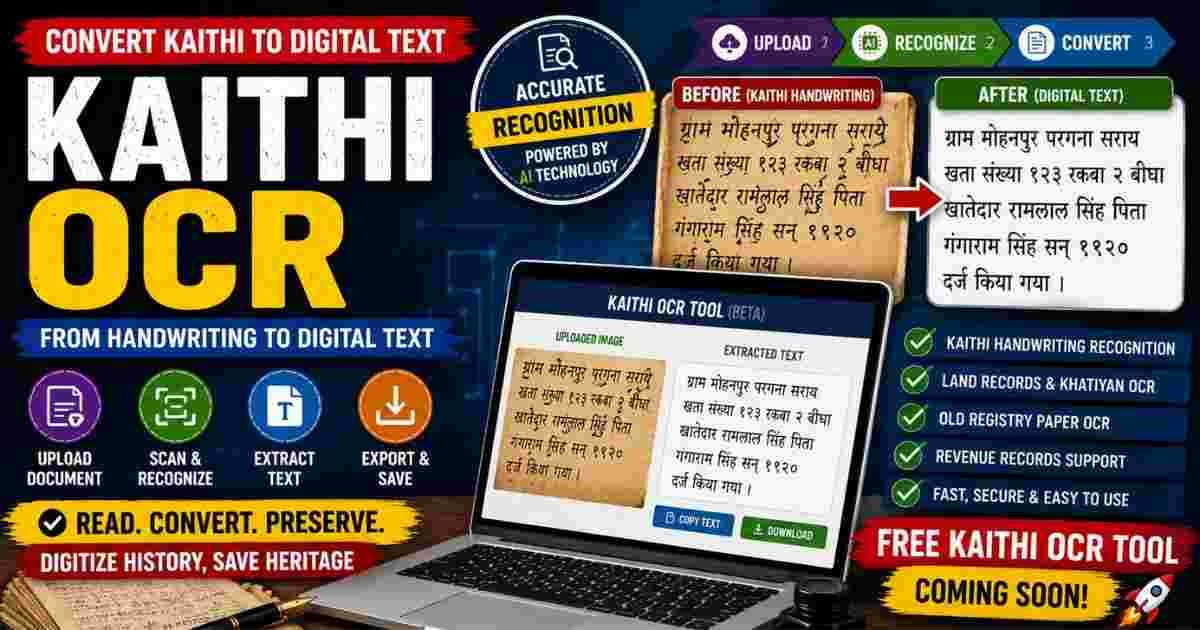
Kaithi OCR: Convert Kaithi Handwriting & Documents to Digital Text
Agar aapke paas old Kaithi documents, handwritten records, Khatiyan, registry papers ya historical land records hain, toh unhe digital text me convert karna difficult ho sakta hai. Isi problem ko solve karne ke liye Kaithi OCR technology useful ho sakti hai.
OCR ka full form Optical Character Recognition hai. Simple words me, OCR image ya scanned document me visible characters ko identify karke editable digital text me convert karne ki koshish karta hai.
Kaithi ke case me challenge thoda different hai, kyunki historical documents me handwriting, faded ink, paper damage aur old writing styles recognition ko difficult bana sakte hain.
Is guide me hum Kaithi OCR, handwriting recognition, historical land records, Khatiyan, Kaithi Unicode, Kaithi fonts aur future Kaithi OCR tools ko simple Hinglish me explain karenge.
Important: Kaithi OCR ko automatic legal-document verification tool nahi samajhna chahiye. Historical records ke OCR output ko original document ke saath manually verify karna zaroori hai.
What Is Kaithi OCR?
Kaithi OCR ek OCR-based technology ya proposed tool concept hai jo Kaithi script ke images ya scanned documents se text recognize karne ki koshish karta hai.
Normal OCR systems printed documents ke liye comparatively better perform kar sakte hain. Lekin old Kaithi records me handwritten characters aur unusual writing styles hone ki wajah se recognition challenging ho sakti hai.
Basic process:
Kaithi Image → Character Recognition → Digital Text → Human Review
For example, agar aapke paas ek scanned Kaithi page hai, OCR system image ko analyze karke possible Kaithi characters identify karega.
Result ko editable text ke form me use kiya ja sakta hai, provided the recognition system supports the relevant Kaithi characters.
Kaithi Unicode ke liye official Unicode character range U+11080–U+110CF hai.
How Does Kaithi OCR Work?
Kaithi OCR ka basic workflow several stages me divide kiya ja sakta hai.
Uploading a Kaithi Document
Sabse pehle user ek scanned image, photograph ya supported document upload karta hai.
Image quality yahan bahut important hai. Clear, high-resolution image generally recognition ke liye better starting point provide karti hai.
Detecting Kaithi Characters
OCR system image ke andar text areas identify karne ki koshish karta hai.
Uske baad characters ke shapes ko recognize karne ka process start hota hai.
Recognizing Kaithi Words
Individual characters ko identify karne ke baad system possible words ya character sequences generate kar sakta hai.
Historical handwriting me character boundaries clear na hone par errors increase ho sakte hain.
Converting Kaithi Image to Text
Recognition ke baad detected text ko digital form me convert kiya ja sakta hai.
Agar system Unicode-compatible hai, toh output Kaithi Unicode characters ke form me represent kiya ja sakta hai.
Reviewing the OCR Result
Ye sabse important step hai.
OCR result ko blindly copy karke historical ya property document me use nahi karna chahiye. Original image ke against extracted text ko manually check karein.
Kaithi OCR for Beginners
Agar aap pehli baar Kaithi OCR use kar rahe hain, toh simple workflow follow karein:
- Clear Kaithi document scan karein.
- Image ko crop karke unnecessary background remove karein.
- OCR-compatible system me image upload karein.
- Recognition run karein.
- Extracted text ko review karein.
- Incorrect characters manually correct karein.
- Final text ko original document se compare karein.
Beginners ko especially names, village names, numbers aur land measurements carefully verify karne chahiye.
Agar aap pehle Kaithi characters seekhna chahte hain, toh Kaithi Alphabet guide se start karna useful rahega.
What Types of Kaithi Documents Can OCR Read?
Theoretically, Kaithi OCR different types ke documents ke liye useful ho sakta hai. Lekin actual accuracy document quality aur OCR model par depend karegi.
Kaithi Handwritten Documents
Handwritten Kaithi documents sabse challenging category me aa sakte hain.
Individual writing style, abbreviations aur connected strokes recognition ko difficult bana sakte hain.
Old Kaithi Manuscripts
Old manuscripts me paper deterioration, ink fading aur unusual character forms ho sakte hain.
OCR result ko therefore carefully review karna chahiye.
Kaithi Land Records
Historical land records me Kaithi text ke saath names, plots, villages aur revenue-related information ho sakti hai.
OCR transcription research me helpful ho sakti hai, but legal verification ke liye original records important rahenge.
Khatiyan Records
Old Khatiyan records ko digitize karne ke process me OCR potentially useful ho sakta hai.
Lekin land ownership information ke case me every extracted name, number and description manually verify karna important hai.
Old Registry Papers
Old registry documents me handwritten details aur historical terminology mil sakti hai.
OCR initial transcription ko faster banane me help kar sakta hai, but final reading expert review demand kar sakti hai.
Revenue Records
Historical revenue records me repetitive terms aur structured information hone ki wajah se OCR research workflows me useful ho sakta hai.
Kaithi Handwriting Recognition
Kaithi handwriting recognition aur standard OCR ek hi problem nahi hain.
Printed Kaithi characters relatively consistent ho sakte hain, jabki handwritten Kaithi me:
- individual writing styles;
- abbreviations;
- faded ink;
- overlapping strokes;
- regional variations;
- unusual character shapes
mil sakte hain.
Isi wajah se handwritten historical documents ke liye OCR output ko assisted transcription ki tarah treat karna better hai, final authority ki tarah nahi.
Agar aap handwriting ko manually understand karna chahte hain, toh Kaithi Handwriting guide helpful supporting resource hai.
Kaithi OCR for Historical Land Records
Historical land records ke digitization me Kaithi OCR ka potential important ho sakta hai.
Imagine karein ki kisi archive me thousands of scanned pages hain. Har page ko manually type karna time-consuming ho sakta hai.
OCR ka possible workflow:
Scanned Record → OCR → Digital Text → Human Verification → Digital Archive
Isse researchers ko searchable digital copies create karne me help mil sakti hai.
However, property-related information me OCR error serious consequences create kar sakta hai. Isliye OCR output ko official record ka replacement nahi samajhna chahiye.
Kaithi OCR for Khatiyan Records
Kaithi me available old Khatiyan records researchers ke liye valuable historical information contain kar sakte hain.
OCR ka use:
- names identify karne;
- text searchable banane;
- preliminary transcription create karne;
- digital archives develop karne;
- historical research organize karne
ke liye consider kiya ja sakta hai.
Lekin Khatiyan OCR result ko legal ownership proof nahi samajhna chahiye.
Original record aur current official land records ki verification alag process hai.
Kaithi OCR for Old Registry Documents
Old registry papers ko digitize karte waqt OCR initial text extraction me help kar sakta hai.
A typical workflow:
Document Scan → Image Cleaning → OCR → Text Review → Correction → Digital Archive
Names, dates, locations aur numerical information ko particularly carefully check karein.
Agar document property transaction se related hai, legal interpretation ke liye qualified professional ya appropriate government record verification zaroori ho sakti hai.
Kaithi OCR for Revenue Records
Historical revenue records me repetitive administrative terminology mil sakti hai.
OCR potentially researchers ko:
- documents search karne;
- text categorize karne;
- old records organize karne;
- digital copies prepare karne
me help kar sakta hai.
Lekin terminology ko automatically interpret karna aur legal meaning determine karna OCR ka primary function nahi hai.
How to Use Kaithi OCR Step by Step
Upload a Kaithi Image
Sabse pehle ek clear Kaithi image select karein.
Prefer karein:
- high-resolution scan;
- good lighting;
- straight document;
- minimal shadows;
- readable handwriting.
Select the Document Area
Agar image me unnecessary background hai, toh sirf document/text area crop karein.
Isse OCR system ko relevant area par focus karne me help mil sakti hai.
Run OCR Recognition
OCR engine image ke characters identify karne ki process perform karega.
Recognition time tool aur document size par depend karega.
Check the Extracted Text
Output ko line-by-line original document ke against compare karein.
Particularly check:
- personal names;
- village names;
- numbers;
- dates;
- plot details;
- abbreviations.
Correct Recognition Errors
OCR mistakes ko manually correct karein.
Historical documents me context ka knowledge correction process ko easier bana sakta hai.
Export Digital Kaithi Text
Verified text ko supported format me save kiya ja sakta hai.
Agar Unicode Kaithi output available hai, toh text ko modern digital systems me process aur display karna easier ho sakta hai.
Kaithi OCR vs Manual Transcription
| Kaithi OCR | Manual Transcription |
| Faster initial extraction | Usually slower |
| Automation possible | Human interpretation |
| Large document collections ke liye useful | Small/complex documents ke liye useful |
| Recognition errors ho sakte hain | Human errors bhi possible |
| Review required | Expert review possible |
Best approach kai cases me OCR + human verification ho sakta hai.
OCR repetitive initial work reduce kar sakta hai, while human reviewer historical context aur unclear handwriting ko interpret kar sakta hai.
Kaithi OCR vs Kaithi Translator
Ye dono tools different purposes serve karte hain.
OCR:
Image → Digital Text
Translator:
Text → Another Language
Transliteration:
One Script → Another Script
Example:
Aap ek Kaithi handwritten document upload karte hain.
Kaithi OCR us image ko digital text me convert karne ki koshish karega.
Uske baad Kaithi Translator ya translation workflow us text ka meaning Hindi/English me provide karne ki koshish kar sakta hai.
Isliye OCR aur translation ko same technology nahi samajhna chahiye.
Aap future tool concept ke liye Kaithi Translator page explore kar sakte hain.
Kaithi OCR and Kaithi Unicode
OCR output ko digital Kaithi text ke form me represent karne ke liye Unicode important ho sakta hai.
Official Unicode data ke according Kaithi ka encoded range U+11080–U+110CF hai. Is range me Kaithi letters, vowel signs, virama, signs aur punctuation included hain.
Simple workflow:
Image → OCR → Kaithi Unicode Text → Font → Display
Aap detailed encoding information ke liye Kaithi Unicode guide read kar sakte hain.
Kaithi OCR and Kaithi Fonts
OCR aur font ka role different hai.
OCR: image se text identify karne ki koshish karta hai.
Font: digital characters ko screen par visually display karta hai.
Agar OCR output Unicode Kaithi text hai, toh appropriate font/rendering support ke bina characters correctly display nahi ho sakte.
Isliye digital Kaithi workflow me:
OCR + Unicode + Font
teen separate components ko samajhna useful hai.
Aap Kaithi Font Download guide se font-related information explore kar sakte hain.
Can Kaithi OCR Read Handwriting?
Potentially, but accuracy guaranteed nahi hai.
Clear Handwriting
Clear and consistent handwriting recognition ke liye comparatively easier ho sakti hai.
Faded Documents
Faded ink ki wajah se character shapes incomplete ho sakti hain.
Damaged Documents
Torn, folded or damaged pages OCR ke liye difficult ho sakte hain.
Different Handwriting Styles
Different writers same Kaithi character ko different shapes me likh sakte hain.
Historical Spelling Variations
Old records me spelling aur abbreviation conventions modern expectations se different ho sakte hain.
Isliye historical handwriting OCR ko always human review ke saath use karna better hai.
Factors That Affect Kaithi OCR Accuracy
Image Quality
High-quality scans generally better input provide karte hain.
Handwriting Clarity
Clear strokes recognition ko easier bana sakte hain.
Document Condition
Faded, damaged or stained paper OCR performance ko reduce kar sakta hai.
Character Style
Unusual handwriting forms recognition errors create kar sakti hain.
Language and Context
Kaithi historically multiple languages ke liye use hui thi. Unicode documentation ke according Kaithi ka use Bhojpuri, Magahi, Awadhi, Maithili, Urdu aur Hindi se related languages ko write karne ke liye bhi hua.
Isliye sirf script recognize karna aur complete language meaning understand karna different tasks hain.
Common Kaithi OCR Problems
Incorrect Character Recognition
Similar-looking characters confuse ho sakte hain.
Missing Characters
Faded ya unclear areas me characters miss ho sakte hain.
Wrong Word Recognition
OCR system character sequence ko incorrect word ke form me interpret kar sakta hai.
Blurred Text
Low-resolution photos OCR accuracy reduce kar sakti hain.
Faded Ink
Old documents me faded ink major challenge ho sakta hai.
Unusual Handwriting
Highly individual handwriting OCR ke liye difficult ho sakti hai.
Free Kaithi OCR Tool — Coming Soon
Hum future me ek Free Kaithi OCR Tool develop karne ka plan rakh sakte hain jo users ko Kaithi document images se digital text extract karne me help kare.
Possible features:
- Kaithi image upload
- OCR text extraction
- Unicode output
- Copy text
- Download text
- Basic image preprocessing
- Manual correction
- Historical document support
Important: Tool availability, supported formats aur recognition accuracy implementation ke time par depend karegi.
Is page par future tool ko “coming soon” ke roop me describe karna better hai jab tak actual working tool available na ho.
How to Use Our Future Kaithi OCR Tool
Upload Kaithi Image
User apna scanned Kaithi document ya image upload kar sakega.
Select OCR Language
Future version me Kaithi recognition option provide kiya ja sakta hai.
Start Recognition
Tool uploaded image ko process karke possible text generate karega.
Review Extracted Text
User original image ke saath output compare kar sakega.
Copy or Download the Result
Verified text ko copy ya supported format me download karne ka option future tool me add kiya ja sakta hai.
How Accurate Is Kaithi OCR?
Kaithi OCR ki accuracy ko ek fixed percentage ke roop me guarantee nahi kiya ja sakta.
Accuracy depend karegi on:
- OCR model;
- training data;
- image quality;
- handwriting;
- document condition;
- language;
- historical writing style;
- character recognition;
- preprocessing.
Printed Kaithi aur handwritten Kaithi ke results bhi significantly different ho sakte hain.
Isliye article me unrealistic claims jaise “99.9% accurate Kaithi OCR” avoid karna better hai jab tak independently verified testing data available na ho.
Limitations of Kaithi OCR
Kaithi OCR powerful research assistance provide kar sakta hai, but limitations bhi hain.
It may struggle with:
- very old handwriting;
- damaged documents;
- faded ink;
- unusual abbreviations;
- overlapping characters;
- poor photographs;
- mixed scripts;
- unclear numbers.
Most importantly, OCR legal interpretation nahi karta.
Agar document property ownership, inheritance, registry ya land dispute se related hai, OCR output ko final legal evidence ke roop me use nahi karna chahiye.
How to Improve Kaithi OCR Results
Better results ke liye document preparation important hai.
Try these steps:
- Highest practical resolution me scan karein.
- Document ko flat rakhein.
- Shadows avoid karein.
- Image ko properly crop karein.
- Background noise reduce karein.
- Text orientation correct karein.
- Very faded sections ko separately process karein.
- OCR output ko manually proofread karein.
Ek difficult page ko ek baar me process karne ke bajay smaller sections me process karna bhi useful ho sakta hai.
Kaithi OCR for Digital Preservation
Historical Kaithi records ko digitize karna cultural aur research perspective se valuable ho sakta hai.
Digital preservation workflow kuch is tarah ho sakta hai:
Original Document → High-Quality Scan → OCR/Transcription → Unicode Text → Metadata → Digital Archive
OCR yahan ek supporting technology hai.
Original image ko preserve karna equally important hai because OCR output me errors ho sakte hain.
Researchers future me digital text ko search, categorize aur compare kar sakte hain.
Kaithi OCR and Historical Land Records
Historical land records ke context me OCR ka potential especially interesting hai.
Kaithi records me land-related names, villages, ownership references, measurements aur administrative terminology mil sakti hai.
OCR researchers ko large collections ko process karne me help kar sakta hai.
However:
OCR result ≠ verified land ownership record
Agar aap kisi property ka current ownership, mutation, title ya legal status verify kar rahe hain, toh appropriate government records aur qualified professional guidance ko priority dein.
Aap Kaithi records ko samajhne ke liye Kaithi Script Guide bhi refer kar sakte hain.
Useful Kaithi OCR Trusted External Guides & Reference Sources
Official Unicode Kaithi Character Chart
Official Unicode Kaithi Character Chart
Official Unicode chart Kaithi characters aur their code points ko reference karne ke liye useful hai.
Unicode Kaithi Names List
Is resource me Kaithi characters ke Unicode names aur code points listed hain.
Unicode Standard — Kaithi
Unicode Standard Kaithi Script
Unicode documentation Kaithi ke historical use, encoding range aur script-related technical information provide karta hai.
Conclusion
Kaithi OCR historical Kaithi documents ko digital form me preserve, search aur study karne ke liye ek promising technology concept hai.
Iska potential Kaithi handwriting, Khatiyan records, old registry papers, revenue records aur historical land documents ke digitization me ho sakta hai.
Lekin OCR ko final authority nahi samajhna chahiye. Old documents me handwriting variation, faded ink, damaged paper aur historical terminology ki wajah se errors possible hain.
Best workflow hai:
Scan → OCR → Unicode Text → Human Verification → Digital Preservation
Kaithi Unicode officially U+11080–U+110CF range me encoded hai, aur Unicode ke official resources Kaithi characters ko detailed code-point information ke saath document karte hain.
Aapke Kaithi content cluster ke liye recommended learning path ab hai:
Kaithi Script Guide → Kaithi Alphabet → Kaithi Numbers → Learn Kaithi Script → Kaithi Handwriting → Kaithi Translator → Kaithi Unicode → Kaithi Font Download → Kaithi OCR
Frequently Asked Questions
What is Kaithi OCR?
Kaithi OCR ek OCR technology/concept hai jo Kaithi script ke scanned ya photographed documents se digital text recognize karne ki koshish karta hai.
Can Kaithi OCR read handwritten documents?
Potentially yes, but handwritten Kaithi OCR challenging ho sakta hai. Handwriting style, faded ink, image quality aur document condition accuracy ko affect karte hain.
Can Kaithi OCR convert images to text?
Yes, OCR ka basic purpose image-based text ko machine-readable digital text me convert karna hai. Kaithi ke case me actual performance available OCR technology par depend karegi.
Can Kaithi OCR read old land records?
It may assist with transcription of old Kaithi land records, but extracted information ko original document ke against verify karna important hai.
Can Kaithi OCR read Khatiyan records?
Kaithi Khatiyan images ko OCR workflow me process kiya ja sakta hai, provided the recognition system supports the script and document quality is sufficient.
How accurate is Kaithi OCR?
Accuracy fixed nahi hoti. Clear printed text aur difficult handwritten historical records ke results significantly differ kar sakte hain.
Is Kaithi OCR free?
Future Free Kaithi OCR Tool availability website implementation par depend karegi. Jab tak actual tool launch nahi hota, “coming soon” information ko clearly mention karna best hai.
Can Kaithi OCR convert Kaithi to Hindi?
OCR ka primary function image → text hai. Kaithi ko Hindi meaning me convert karna translation ka separate step hai.
Is Kaithi OCR the same as a Kaithi Translator?
No.
Kaithi OCR: Image → Digital Text
Kaithi Translator: Text → Another Language
Kaithi Transliteration: Kaithi Script → Another Script
Ye three different processes hain.
7 thoughts on “Kaithi OCR: Convert Kaithi Handwriting & Documents to Digital Text”