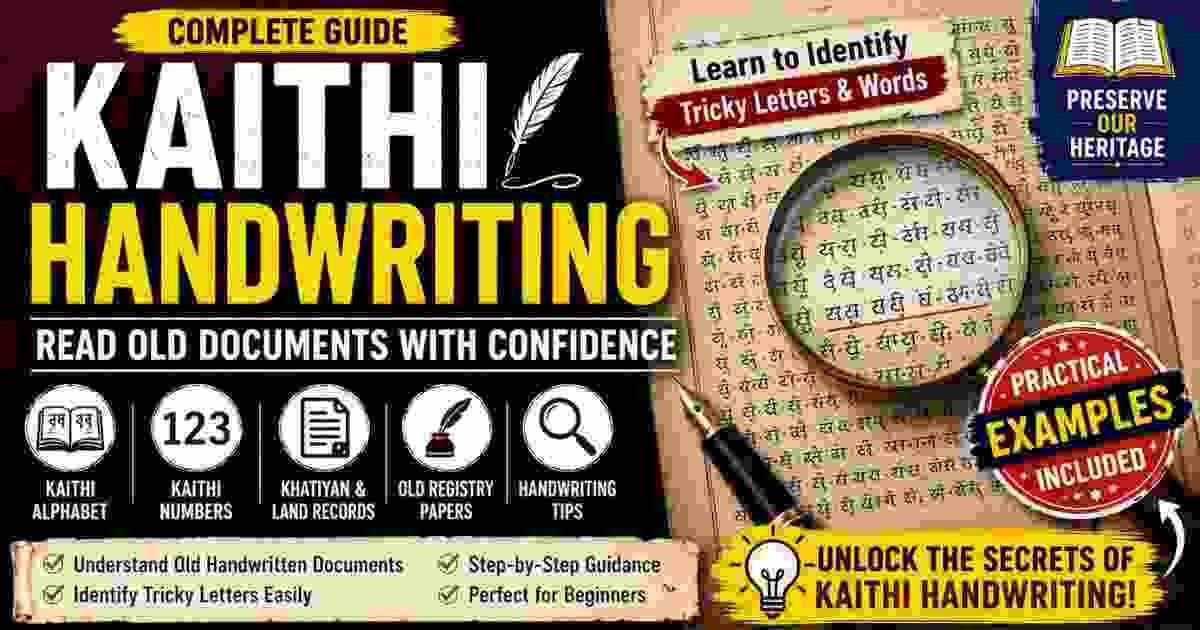
Kaithi Handwriting: Complete Guide to Reading Old Handwritten Documents
Agar aapke paas purane Khatiyan, land records, registry papers, revenue documents ya ancestral property papers hain, toh unmein likhi handwriting ko samajhna challenging ho sakta hai. Kaithi script khud ek historical writing system hai, lekin handwritten Kaithi documents me difficulty aur badh jaati hai because har writer ka writing style, speed aur character formation thoda different ho sakta hai. Isi wajah se Kaithi Handwriting ko samajhne ke liye sirf alphabet memorize karna enough nahi hota; aapko letter shapes, spacing, abbreviations, numbers aur document context ko bhi observe karna padta hai.
Kaithi historically North India, especially present-day Bihar aur Uttar Pradesh, me administrative, commercial, personal aur other written purposes ke liye use hoti thi. Unicode ke official documentation ke according, Kaithi ka administrative use 16th century se early 20th century tak documented hai, aur isme Bhojpuri, Magahi, Awadhi, Maithili, Urdu aur related languages likhi ja sakti thi.
Is guide ka objective beginners ko Kaithi Handwriting read karne ka practical framework dena hai. Yahan aap handwriting variations, difficult characters, Kaithi numbers, Khatiyan entries, old registry papers aur historical land documents ko step by step understand karenge.
What Is Kaithi Handwriting?
Kaithi Handwriting ka simple meaning hai Kaithi script ko handwritten form me read aur identify karna. Printed Kaithi characters comparatively standardized dikh sakte hain, lekin old handwritten documents me character shapes writer ke style ke according change ho sakte hain.
Kaithi ko Devanagari ki tarah automatically same appearance wala script samajhna mistake ho sakta hai. Unicode documentation specifically batata hai ki Kaithi Devanagari se related hai, lekin Kaithi me Devanagari jaisa continuous headstroke generally use nahi hota. Kuch manuscripts aur books me ruled line dikh sakti hai, lekin woh individual letters ke upar Devanagari headline ki tarah broken nahi hoti.
Isliye jab aap old document dekhte hain, toh sabse pehle script ki overall visual style identify karein. Uske baad individual characters ko compare karein.
Why Is Kaithi Handwriting Difficult to Read?
Historical handwriting ko read karna modern printed text padhne jaisa simple nahi hota. Writer ki speed, pen pressure, character joining, abbreviations aur document condition reading ko difficult bana sakte hain.
Ek hi character alag documents me thoda different appear kar sakta hai. Kabhi-kabhi ink faded hoti hai, paper damaged hota hai, ya letters ek doosre ke close likhe hote hain.
Isi reason se Kaithi Handwriting seekhte waqt ek single alphabet chart par depend karna enough nahi hai. Aapko multiple handwritten examples compare karne chahiye aur context ke basis par reading confirm karni chahiye.
Kaithi Handwriting vs Printed Kaithi
Printed Kaithi aur handwritten Kaithi ke beech difference samajhna beginners ke liye important hai. Printed characters usually cleaner aur more consistent hote hain, jabki handwritten characters fast strokes aur individual writing habits ki wajah se less predictable ho sakte hain.
Unicode ke Kaithi documentation me bhi handwritten text ke specific behavior ka discussion milta hai. For example, short aur long vowel forms ka distinction handwritten text me printed form ke comparison me different tarike se appear kar sakta hai.
Isliye Kaithi Handwriting practice ke liye printed chart ko starting point rakhein, final reference nahi.
How to Read Kaithi Handwriting Step by Step
Step 1: Identify the Document Type
Sabse pehle ye samjhein ki aapke saamne kis type ka document hai.
Kya ye Khatiyan hai? Kya ye old registry paper hai? Kya ye revenue entry hai? Ya personal letter ya bahi-khata hai?
Document type identify karne se possible vocabulary aur writing style ka context mil sakta hai.
Step 2: Find Clear Characters
Poori line ko ek saath read karne ki koshish mat karein. Sabse pehle clearly visible characters identify karein.
Jo characters clear hain unhe reference points ki tarah use karein.
Step 3: Compare Repeated Characters
Agar same character document me multiple times appear ho raha hai, toh uske different examples compare karein.
Ek unclear character ko doosri clear occurrence ke saath compare karna often useful hota hai.
Step 4: Identify Numbers
Land records me numbers extremely important ho sakte hain. Khata Number, Plot Number, Survey Number, dates aur land measurements ko separately note karein.
Agar aapne pehle Kaithi Numbers nahi seekhe hain, toh hamari Kaithi Numbers Guide ko supporting resource ke roop me use karein.
Step 5: Read Words Through Context
Individual characters identify karne ke baad complete word ko understand karein.
Kabhi-kabhi ek letter unclear hota hai, lekin complete word aur surrounding sentence uska likely reading pattern suggest kar sakta hai.
Step 6: Compare Multiple Lines
Ek line se conclusion mat nikalein. Same handwriting ko document ke multiple sections me compare karein.
Step 7: Transcribe Before Translating
Pehle original handwriting ko Roman ya Devanagari transcription me record karein. Uske baad meaning translate karein.
Ye method direct guessing se safer hota hai.
Learn Kaithi Alphabet for Better Handwriting Recognition
Agar aap Kaithi Handwriting read karna chahte hain, toh alphabet ka basic knowledge essential hai.
Letters ke shape, vowel signs aur consonants ko identify karna seekhein. Phir unhi characters ko handwritten examples me locate karein.
Hamare [Kaithi Alphabet Guide] ko Cluster 4 page ke saath internally connect karna useful rahega. Alphabet page aapko basic character recognition dega, jabki ye page handwriting variation aur document reading par focus karega.
Unicode ka official [Kaithi Character Chart] bhi individual encoded characters ko reference karne ke liye useful resource hai.
Learn Kaithi Numbers for Old Documents
Kaithi Numbers ko samajhna historical land records ke liye particularly important hai.
Old Khatiyan ya revenue papers me numerical information owner names jitni hi important ho sakti hai. Khata Number, Plot Number, Survey Number, dates aur measurements me ek digit ka difference bhi interpretation change kar sakta hai.
Aapka learning sequence simple hona chahiye:
Kaithi Alphabet → Kaithi Numbers → Kaithi Handwriting → Khatiyan Reading → Old Registry Papers
Kaithi Handwriting in Khatiyan Records
Khatiyan read karte waqt handwriting ke saath document structure ko bhi samajhna important hai.
Pehle headings aur columns identify karein. Uske baad names, numbers, land descriptions aur other entries ko separately read karein.
Agar ek entry unclear hai, toh surrounding rows aur repeated terms ko compare karein. Historical records ko modern Digital Land Records ke saath compare karna useful ho sakta hai, lekin dono records ko automatically identical assume nahi karna chahiye.
Aapke Pillar page [Kaithi Script Guide: Learn to Read Historical Land Records] se is section ko internally link karna strong topical connection create karega.
Kaithi Handwriting in Old Registry Papers
Old Registry Papers me handwriting aur formal terminology dono challenging ho sakte hain.
Document date, parties ke names, village names, property description aur numerical details ko separately identify karein.
Agar paper damaged ya faded hai, toh unclear section ko guess karne ke bajay usse mark karein. Baad me same word ya character document ke kisi aur section me mil sakta hai.
Property-related document ko read karna aur uska legal meaning determine karna alag tasks hain. Important property matters me historical reading ko final legal conclusion nahi maana jaana chahiye.
Common Kaithi Handwriting Styles and Variations
Historical handwriting me ek fixed visual style expect karna practical nahi hai. Different writers aur periods ke documents me letter formation vary kar sakti hai.
Character Size Variation
Kuch writers large characters use kar sakte hain, while others compact writing karte hain.
Joined Strokes
Fast handwriting me neighbouring strokes visually connected appear ho sakte hain.
Abbreviations
Kaithi documentation me abbreviation signs ka use bhi documented hai. Unicode Kaithi block me specific Kaithi Abbreviation Sign encoded hai.
Isliye old document me short forms dekhkar unhe automatically spelling mistake assume na karein.
Common Abbreviations Used in Land Records
Purane land records, Khatiyan, aur Jamabandi documents mein kai lambe shabdon ko chhote roop (Abbreviations / Short Forms) mein likha jata hai. Inhe samajhna purane dastawez padhne ke liye bohot zaroori hai:
| Abbreviation (संक्षिप्त शब्द) | Full Form (पूरा नाम) | Meaning (अर्थ) |
| Kh. (खा.) | Khata Number (खाता संख्या) | Landholding Record ID / Account Number |
| P. (प्.) | Plot / Khesra Number (खेसरा संख्या) | Plot identification number |
| Th. (था.) | Thana Number (थाना संख्या) | Police station jurisdiction number |
| Th. No. (था. नं.) | Revenue Thana Number | Revenue division code for village |
| Mauza (मौजा) | Village Name (ग्राम/गांव) | Official village name in revenue records |
| S/O / D/O | Son of / Daughter of | Pita ya mata ka naam |
| Rakba (रकबा) | Total Area | Jameen ka kul kshetrafal (Area) |
| D. (डि.) | Decimal (डिसमिल) | Unit of land measurement |
| L.R. (एल.आर.) | Land Reforms | Adhunik land record system |
| C.S. / R.S. | Cadastral / Revisional Survey | Purana ya naya zameen survey |
Regional and Language Differences
Kaithi ek script hai, single language nahi. Historical sources document karte hain ki Kaithi me multiple North Indian languages likhi ja sakti thi.
Isliye document ka region aur language context reading me important ho sakta hai.
How to Identify Difficult Kaithi Characters
Jab koi character samajh nahi aa raha ho, toh immediate translation avoid karein.
Pehle us character ko crop ya note karein. Phir document ke other sections me same shape search karein.
Agar same writer ne character multiple times likha hai, toh repeated examples se pattern clearer ho sakta hai.
Use Context
Character ke left aur right words dekhein. Land record context me recurring terms expected ho sakte hain.
Compare Similar Characters
Similar-looking characters ko side-by-side compare karein. Difference stroke direction, loop, dot ya terminal mark me ho sakta hai.
Check Numbers Separately
Agar character numerical entry ka part hai, toh usse normal alphabet character ke roop me read karne ki koshish na karein.
Common Mistakes While Reading Kaithi Handwriting
Modern Hindi Letters Assume Karna
Kaithi aur Devanagari related scripts hain, lekin unke visual forms automatically identical nahi hain.
Har Document Ko Same Samajhna
Different writers, periods aur document types me handwriting variation possible hai.
Unclear Word Ko Guess Karna
Guessing se ek wrong reading poore sentence ka meaning change kar sakti hai.
Numbers Ignore Karna
Land records me numerical information highly significant hoti hai.
Historical and Current Records Mix Karna
Old Revenue Records aur current online records ko context ke saath compare karein.
Legal Meaning Khud Decide Karna
Historical document reading educational research ka part ho sakti hai, lekin legal ownership determination ke liye official verification zaroori hai.
Kaithi Handwriting and Historical Land Records
Historical Land Records me handwriting research particularly useful ho sakti hai because many old records were created before modern digital record systems existed.
Aapko Khatiyan, old registry papers, revenue entries, land maps aur family property documents me different handwriting patterns mil sakte hain.
Agar aap ancestral property research kar rahe hain, toh ek single document ke bajay multiple records ko timeline ke form me arrange karna better approach hai.
For example, old record me owner name aur plot reference identify karein, phir available modern Land Record Search resources me corresponding information check karein.
Kaithi Handwriting and Ancestral Property Research
Aapke family ke old documents me names, villages, land references aur transactions ke historical clues ho sakte hain.
Ancestral Property research ke liye handwriting reading ek useful first step ho sakti hai, lekin final ownership establish karne ke liye current official records aur applicable legal documentation ko verify karna important hai.
Old document ko family history ka clue samjhein, automatic current Property Ownership Proof nahi.
Kaithi Handwriting and Digital Land Records
Aaj ke time me many land-record systems digitized form me available hain. However, historical paper records aur modern digital entries ka format different ho sakta hai.
Isliye Digital Land Records ko old handwritten documents ke replacement ke roop me nahi, balki comparison aur verification ke ek possible source ke roop me use karein.
Aapka [Learn Kaithi Script Guide] basic reading skills ke liye aur Kaithi Handwriting page practical handwriting recognition ke liye work karega.
Best Way to Practice Kaithi Handwriting
Regular practice sabse important hai.
Practice With Short Samples
Long documents se start karne ke bajay short handwritten entries choose karein.
Create a Character Notebook
Difficult characters ke handwritten examples collect karein.
Build a Word List
Frequently appearing names, places aur revenue terms ko note karein.
Practice Numbers
Dates aur land-record numbers ko separately practice karein.
Compare Multiple Documents
Different writers ke documents compare karne se visual flexibility improve hoti hai.
Useful Resources for Kaithi Handwriting
Aap Kaithi Handwriting ko ek standalone topic ke roop me study karne ke bajay related resources ke saath combine karein.
Explore More Land Record Guides
- Complete Kaithi Script Guide → kaithi-script-guide
- Kaithi Alphabet Guide → kaithi-alphabet
- Kaithi Numbers Guide → kaithi-numbers
- Learn Kaithi Script → learn-kaithi-script
- How to Read Kaithi Khatiyan → Read-kaithi
- Kaithi Revenue Terms →
Official Portals & Verification Resources
Unicode’s official documentation is particularly useful because it provides information about Kaithi’s historical use, character repertoire, writing behavior and digit-related details.
Conclusion
Kaithi Handwriting ko read karna ek skill hai jo patience, observation aur regular practice se improve hoti hai. Sirf alphabet memorize karna enough nahi hai; aapko handwritten character variations, numbers, abbreviations, document structure aur historical context ko bhi understand karna hoga.
Agar aap beginner hain, toh pehle Kaithi Alphabet, phir Kaithi Numbers, uske baad Learn Kaithi Script aur finally practical Kaithi Handwriting examples par focus karein.
Historical Khatiyan, old registry papers, revenue records aur ancestral property documents ko read karte waqt guessing avoid karein. Clear characters ko reference banayein, repeated handwriting compare karein aur numerical details ko carefully verify karein.
Sabse effective learning path hai:
Kaithi Script Guide → Kaithi Alphabet → Kaithi Numbers → Learn Kaithi Script → Kaithi Handwriting → Khatiyan Reading
Is structure ke through aapki website par each page ka separate search intent rahega aur users ko ek logical learning journey milegi.
Frequently Asked Questions
-
What is Kaithi Handwriting?
Kaithi Handwriting means handwritten text produced using the historical Kaithi script. Reading it requires familiarity with Kaithi characters as well as handwriting variations.
-
Why is Kaithi Handwriting difficult to read?
Old handwriting can vary because of writer style, speed, abbreviations, faded ink and document condition. Therefore, beginners should compare repeated characters and use document context.
-
Can I learn Kaithi Handwriting online?
Yes, you can begin online by learning the alphabet, numbers, character forms and historical document patterns. However, practical handwritten samples are important for developing recognition skills.
-
Is Kaithi Handwriting useful for reading Khatiyan?
Yes, understanding handwritten Kaithi can help you recognize entries in historical documents, including some old land and revenue records. However, document-specific verification may still be required.
-
Is Kaithi the same as Hindi?
No. Kaithi is a script, while Hindi is a language. Historical sources document Kaithi being used to write multiple languages in North India.
-
Can Kaithi Handwriting prove property ownership?
No. Reading a historical document does not by itself establish current legal ownership. Property information should be checked against relevant official records and professional legal advice where necessary.
9 thoughts on “Kaithi Handwriting: Complete Guide to Reading Old Handwritten Documents”