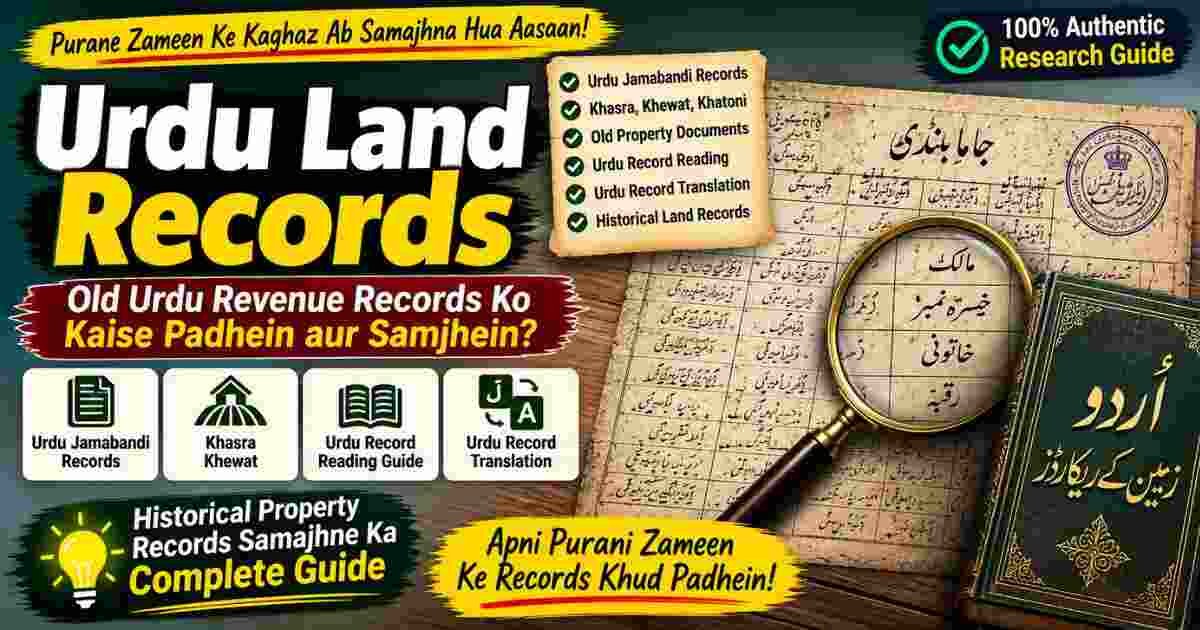
Urdu Land Records: Old Urdu Revenue Records Kaise Padhein aur Samjhein?
Purane Urdu Land Records ko padhna bahut se logon ke liye difficult ho sakta hai, especially jab record purani Urdu handwriting, Nastaliq style, revenue terminology ya faded ink mein likha hua ho.
Punjab, Haryana aur North India ke kai historical property documents mein Urdu terminology aur old revenue expressions mil sakte hain. In records mein Jamabandi, Khasra, Khewat, Khatoni, Girdawari, Mutation, Fard aur ownership se related information mil sakti hai.
Is detailed guide mein hum Urdu Land Records ko identify karne, important terms samajhne, old documents ko read karne aur historical property records ko carefully interpret karne ka practical method dekhenge.
Important: Historical land records ko samajhna educational purpose ke liye useful hai. Ownership, inheritance, sale ya legal dispute ke case mein original certified records aur qualified legal/revenue professionals ki advice ko priority dein.
What Are Urdu Land Records?
Urdu Land Records se generally un historical land, revenue, ownership aur property-related documents ko refer kiya ja sakta hai jahan Urdu language ya Urdu script ka use hua ho.
Purane administrative systems mein revenue offices aur courts mein Urdu documentation ka use kai regions mein hua. Isliye old documents mein modern Hindi ya English terminology ke bajay traditional Urdu/Persian-influenced revenue vocabulary mil sakti hai.
Ek old record mein aapko ye information mil sakti hai:
- Land owner ya recorded holder ka naam
- Father ya predecessor ka naam
- Village ya estate ka naam
- Khewat number
- Khatoni number
- Khasra number
- Land area
- Cultivation details
- Revenue information
- Mutation references
- Tenancy information
- Transfer ya inheritance entries
Isliye Urdu Land Records sirf language documents nahi hain. Ye historical land administration ko samajhne ke important sources bhi ho sakte hain.
Why Are Old Urdu Land Records Important?
Purane Urdu Land Records family history aur property research dono ke liye useful ho sakte hain.
Agar aapke family ke paas 50, 80 ya 100 saal purana land document hai, to usme aise names aur property references ho sakte hain jo modern online records mein easily visible nahi hote.
Historical Property Research
Old records se researchers ko historical ownership patterns aur property transactions ko understand karne mein help mil sakti hai.
Family History Research
Purane land documents mein ancestors ke names, village references aur family relationships mil sakte hain.
Revenue History
Revenue documents se pata chal sakta hai ki particular land parcel ko historical administration mein kis tarah record kiya gaya tha.
Land Record Comparison
Old document ko newer Jamabandi ya other revenue records ke saath compare karke changes ko study kiya ja sakta hai.
How to Read Old Urdu Land Records?
Old Urdu Land Records ko directly translate karne ki jagah pehle document ka structure samajhna better hota hai.
Step 1: Document Type Identify Karein
Sabse pehle dekhein document kis category ka hai:
- Jamabandi
- Khasra record
- Girdawari
- Mutation entry
- Fard
- Registry/deed
- Revenue order
- Court-related property document
Document type identify hone ke baad terminology ko understand karna easier ho jata hai.
Step 2: Village aur Location Identify Karein
Record mein village, tehsil, district ya estate ka reference search karein.
Purane documents mein place names ki spelling modern spelling se different ho sakti hai.
Step 3: Names Carefully Read Karein
Names ko ek hi reading par final na karein.
Old handwriting mein similar-looking letters ki wajah se ek naam ko read karna difficult ho sakta hai.
Step 4: Khasra Number Check Karein
Khasra number property identification mein important reference ho sakta hai.
Agar same number modern records mein available hai, to comparison useful ho sakta hai.
Step 5: Khewat aur Khatoni References Dekhein
Khewat aur Khatoni jaise terms ko identify karein. Inka exact administrative meaning record system aur period ke according context mein samajhna chahiye.
Step 6: Date aur Mutation References Check Karein
Transfer, inheritance ya other changes ke references ke liye dates aur mutation-related entries dekhein.
Urdu Land Record Reading: Important Terms
Old Urdu Land Records mein traditional revenue terminology sabse challenging part ho sakti hai.
Neeche ek beginner-friendly glossary diya gaya hai.
| Term | Simple Meaning |
| Jamabandi | Land/revenue record associated with holdings and rights |
| Khasra | Specific land parcel/field reference |
| Khewat | Ownership/holding-related account reference |
| Khatoni | Cultivation/holding-related record reference |
| Girdawari | Crop/cultivation inspection record |
| Mutation | Record mein change/transfer ki entry |
| Fard | Record ki extract/copy, context ke according |
| Raqba | Land area |
| Malik | Owner/recorded proprietor context |
| Kashtkar | Cultivator/tenant context |
| Waris | Heir/inheritor |
| Intqal | Mutation/transfer entry ke context mein use hone wala term |
Note: Ek historical document mein terminology ka exact meaning us particular record system, period aur local administrative practice par depend kar sakta hai.
Urdu Revenue Records Kya Hote Hain?
Urdu Revenue Records historical administration mein land, cultivation, ownership aur revenue-related information record karne ke liye use kiye ja sakte the.
Aise records mein language ke saath-saath administrative vocabulary bhi important hoti hai.
For example, agar kisi page par sirf owner ka naam identify ho gaya, iska matlab ye automatically prove nahi karta ki present-day legal ownership bhi wahi hai.
Historical record ko samajhne ke liye:
Name + Khasra + Khewat + Khatoni + area + date + mutation + supporting documents
ko collectively examine karna better hai.
Urdu Jamabandi Records Kaise Samjhein?
Urdu Jamabandi records ko read karte waqt page ke columns aur headings ko pehle identify karein.
Owner Information
Owner/proprietor-related column mein names ho sakte hain.
Khewat Information
Khewat reference ko note karein.
Khatoni Information
Cultivation ya holding-related information ko context ke saath dekhein.
Khasra Information
Individual parcel references ko identify karein.
Area
Land area ki historical unit modern units se different ho sakti hai. Conversion karne se pehle original unit identify karein.
Mutation Entries
Ownership ya possession-related changes ke references ko separately track karein.
How to Read Old Urdu Khasra Girdawari?
How to Read Urdu Khasra Girdawari search karne wale users ke liye sabse important point hai ki Girdawari ko ordinary ownership document samajhkar interpret na karein.
Girdawari generally cultivation/crop inspection information se related hoti hai.
Document read karte waqt:
- Village identify karein.
- Khasra number identify karein.
- Relevant agricultural season/year dekhein.
- Cultivator information check karein.
- Crop-related entry identify karein.
- Remarks ya additional notes dekhein.
- Historical entry ko later records se compare karein.
Isse Urdu Land Records ke agricultural context ko better samajhne mein help mil sakti hai.
Urdu Land Record Translation Kaise Karein?
Urdu Land Record Translation sirf Urdu words ko Hindi ya English mein convert karna nahi hai.
Historical document mein teen different levels ho sakte hain:
Script Reading
Pehle handwriting ya script ko correctly identify karna hota hai.
Literal Transcription
Original text ko accurately reproduce kiya jata hai.
Meaning-Based Translation
Uske baad sentence ka meaning Hindi ya English mein explain kiya jata hai.
Ye distinction important hai because ek word ka historical administrative meaning ordinary Urdu dictionary meaning se different ho sakta hai.
Old Urdu Property Records Ko Kaise Padhein?
Old Urdu Property Records ko read karte waqt document ki age aur condition ko seriously lena chahiye.
Faded Ink
Faded ink mein letters incomplete dikh sakte hain.
Damaged Paper
Paper damage ki wajah se words ya numbers missing ho sakte hain.
Old Handwriting
Har writer ki handwriting same nahi hoti.
Historical Spelling
Village aur person names ki historical spelling modern spelling se different ho sakti hai.
Abbreviations
Revenue records mein short forms aur administrative abbreviations mil sakti hain.
Urdu Revenue Terms List Punjab Haryana
Punjab aur Haryana ke historical revenue records ko research karte waqt users ko commonly encountered terms ki glossary maintain karni chahiye.
Useful terms include:
- Jamabandi
- Khasra
- Khewat
- Khatoni
- Girdawari
- Mutation
- Fard
- Raqba
- Malik
- Kashtkar
- Waris
- Intqal
- Registry
- Rapat
- Roznamcha
Lekin kisi term ko isolated word ke basis par interpret karna avoid karein. Urdu Land Records ka meaning document ke complete context se samajhna safer approach hai.
Old Urdu Land Records Punjab Haryana Kaise Padhein?
Punjab aur Haryana ke old records ko samajhne ke liye ek structured approach follow karein.
Punjab Records
Punjab ke official land-record system mein Jamabandi ko owner name, Khewat number, Khasra number aur Khatouni number ke basis par search karne ke options available hain. Official portal mutation, registered deed aur Fard-related services bhi provide karta hai.
Punjab Land Records – Official Portal
Haryana Records
Haryana ke historical records ko interpret karte waqt old document ko available official revenue records aur relevant local administrative records ke saath cross-check karna useful hai.
Important: Historical Urdu record ko modern online record ke saath match karna sirf preliminary research ke liye use karein. Legal ownership establish karne ke liye certified documents aur official verification zaroori ho sakti hai.
Urdu Land Records Aur Historical Research
Historical research mein Urdu Land Records ka value sirf property ownership tak limited nahi hai.
Ye documents local history, settlement patterns, agricultural practices, family history aur administrative systems ko study karne mein bhi useful ho sakte hain.
Researchers ko document ke:
- Date
- Place
- Writer/scribe
- Record type
- Language
- Script style
- Names
- Revenue terminology
- Property references
ko separately document karna chahiye.
Urdu Manuscripts Aur Archival Research
Agar aap historical Urdu documents par deeper research karna chahte hain, authoritative archival collections useful starting point ho sakti hain.
IGNCA ke manuscript resources mein India ke multiple repositories aur collections listed hain. IGNCA ke catalogue mein Urdu-language manuscripts ke examples bhi milte hain, aur researchers ko manuscript collections access karne ke procedures diye gaye hain.
Is type ke authoritative sources se historical terminology ko random blogs ke comparison mein more carefully verify kiya ja sakta hai.
Urdu Land Records vs Modern Digital Land Records
Modern digital land records aur historical Urdu documents ka purpose related ho sakta hai, lekin dono ko automatically identical nahi samajhna chahiye.
| Historical Urdu Record | Modern Digital Record |
| Handwritten/old printed | Digitized |
| Historical terminology | Modern terminology |
| Manual entries | Database-based records |
| Faded/aged documents possible | Usually clearer display |
| Historical spelling | Standardized/current spelling may differ |
| Context-heavy | Search/filter options available |
Punjab ka official land-record portal current aur previous Jamabandi periods ke liye search options provide karta hai.
Urdu Land Record Reading Mein Common Mistakes
Similar Letters Ko Confuse Karna
Old handwriting mein visually similar letters ko incorrectly read karna common mistake hai.
Names Ko Guess Karna
Agar naam unclear hai to guess karna avoid karein.
Numbers Ignore Karna
Khasra, Khewat aur Khatoni references ko ignore karne se document ka context lose ho sakta hai.
Translation Ko Legal Proof Samajhna
Translation explanation hai; automatically legal certification nahi.
Single Document Par Depend Karna
Property research mein multiple supporting records ko compare karna better hai.
How to Verify Old Urdu Land Records?
Verification ke liye ek practical checklist use karein:
Document → Date → Village → Khasra → Khewat → Khatoni → Owner → Mutation → Supporting Record
Punjab ke official portal par Jamabandi ko owner name, Khewat, Khasra aur Khatouni references se search karne ke options listed hain. Portal registered deeds, mutation aur digital Fard services bhi provide karta hai.
Agar historical document aur modern record mein difference mile, to immediately kisi ek record ko “wrong” assume na karein. Pehle intervening mutations, inheritance, partition, corrections aur record periods ko investigate karein.
Conclusion
Urdu Land Records India ke historical land administration aur family property history ko understand karne ka valuable source ho sakte hain. Lekin in records ko read karne ke liye sirf Urdu language knowledge enough nahi hoti.
Aapko script reading + revenue terminology + document structure + historical context + property references ko saath mein samajhna hota hai.
Agar aap old Urdu documents research kar rahe hain, to pehle document type identify karein, phir names, dates, Khasra, Khewat, Khatoni aur mutation references note karein. Finally, available official land-record sources aur archival references ke saath information cross-check karein.
Is approach se old Urdu land records, Urdu revenue documents aur historical property records ko much more systematically samjha ja sakta hai.
Frequently Asked Questions About Urdu Land Records
What are Urdu Land Records?
Urdu Land Records historical land, revenue, ownership aur property-related documents hain jinmein Urdu language/script ya Urdu-based administrative terminology ka use mil sakta hai.
How can I read old Urdu land records?
Pehle document type, village, date, names, Khasra, Khewat aur Khatoni references identify karein. Uske baad terminology aur handwriting ko context ke saath interpret karein.
How to read old Urdu land records in Punjab and Haryana?
Document ke revenue terminology ko identify karke Khasra, Khewat, Khatoni, Jamabandi aur Girdawari references ko systematically compare karein. Modern official records se cross-check karna bhi useful ho sakta hai.
Can old Urdu land records be translated into Hindi?
Yes, historical Urdu documents ko Hindi mein explain ya translate kiya ja sakta hai. Lekin difficult handwriting aur historical terminology ke case mein trained reader/researcher se verification advisable hai.
Can old Urdu land records be translated into English?
Yes. Translation possible hai, lekin literal translation aur historical/legal meaning mein difference ho sakta hai.
What is an Urdu revenue record?
Urdu revenue record generally land, cultivation, ownership, assessment ya administrative information se related historical record ho sakta hai.
What is Urdu Jamabandi?
Urdu Jamabandi historical revenue documentation ka ek form/context ho sakta hai jahan landholding, ownership-related entries aur other revenue information record ki gayi ho.
What is Khasra in old land records?
Khasra generally specific land parcel ya field ko identify karne wala reference number hota hai.
What is Khewat in land records?
Khewat ek holding/ownership-related account reference ke roop mein use hota hai, although exact usage record system aur historical context ke according vary kar sakta hai.
What is Khatoni?
Khatoni generally cultivation/holding-related record reference ke context mein milta hai. Exact interpretation document ke format aur period ko dekhkar karni chahiye.
Can OCR read old Urdu land records?
OCR printed text ke liye useful ho sakta hai, lekin old handwritten Urdu documents mein accuracy significantly vary kar sakti hai. Faded ink, handwriting style aur document damage results ko affect kar sakte hain.
Are Urdu Land Records legally valid today?
Historical document ki legal value document type, provenance, date, jurisdiction aur current law par depend karti hai. Isliye online explanation ko legal ownership proof na samjhein.
3 thoughts on “Urdu Land Records: Old Urdu Revenue Records Kaise Padhein aur Samjhein?”